


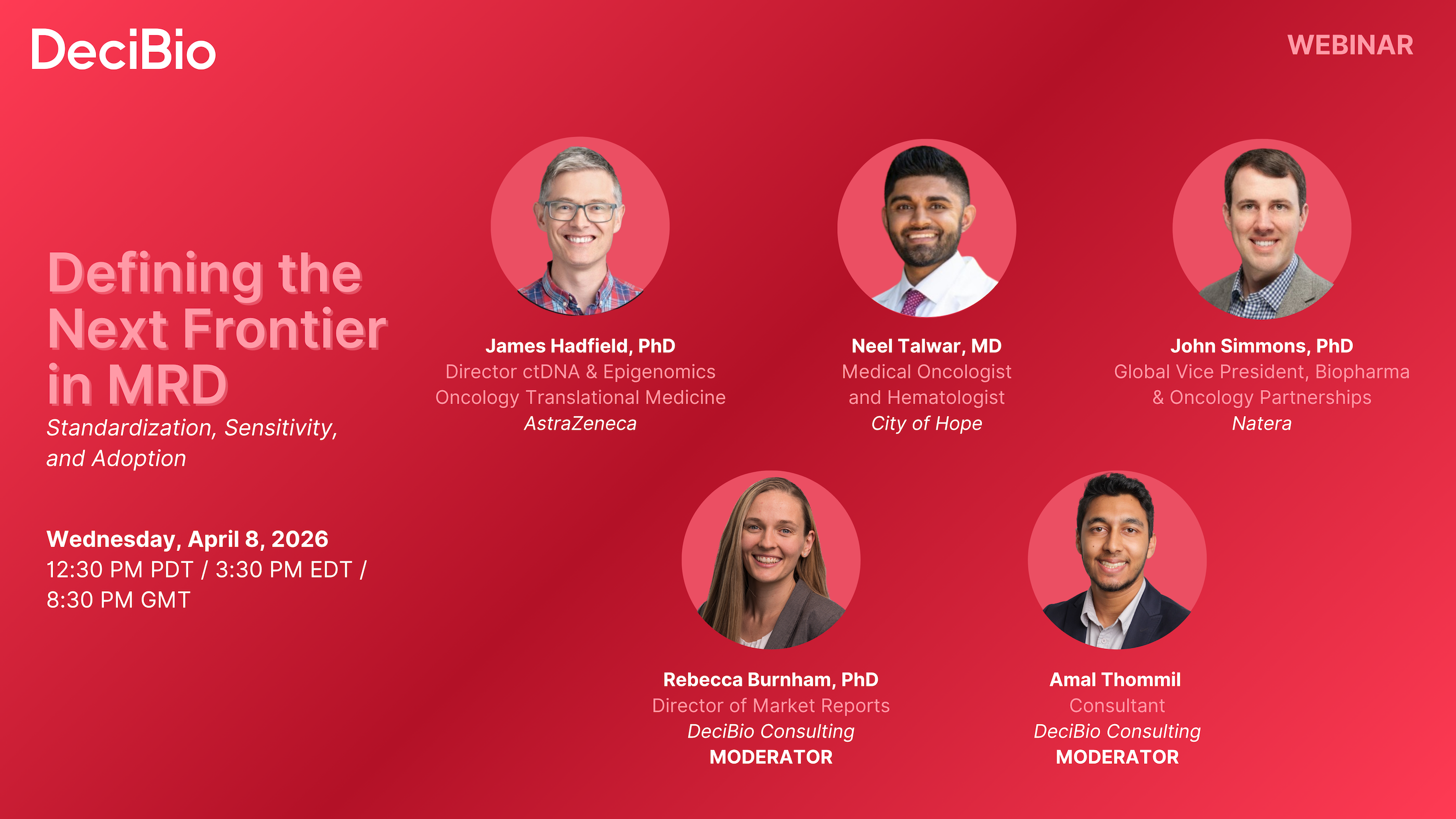
This webinar was recorded on Wednesday, April 8, 2026.
Key Insights from the Solid Tumor MRD Webinar
The MRD testing field for solid tumors is navigating a critical transition. While testing volumes are growing, the market remains significantly under-penetrated due to a lack of standardization and questions surrounding clinical actionability. Our recent webinar featured a panel of experts across the oncology ecosystem to discuss how the industry is addressing differences in protocols or study designs, trade-offs between different assay approaches, and how to evaluate limit of detection (LoD) or sensitivity.
The Standardization Gap: Terminology and Time Points
A primary hurdle to widespread adoption is the lack of uniformity across the MRD landscape. Panelists noted that the term "MRD" itself is evolving from "minimal" to "molecular" residual disease to better reflect its use in longitudinal surveillance or broader use cases. Beyond semantics, the field lacks standardized ctDNA thresholds and consensus on ideal testing windows. Dr. Neel Talwar highlighted that testing too soon after surgery may lead to false negatives, underscoring the need for consistent, data-driven time points for data collection.
Tumor-Informed vs. Tumor-Naive: Balancing Speed and Sensitivity
The debate between tumor-informed (tissue-based) and tumor-naive (tissue-free) assays centers on the trade-off between speed and analytical depth. Tumor-informed assays remain the clinical preference due to superior sensitivity and established clinical evidence. However, tumor-naive tests may serve as a vital "better than nothing" alternative when tissue is scarce or when clinical decisions require a rapid one-week turnaround. James Hadfield noted that as we understand disease biology better, we may find specific settings where one approach is clearly superior to the other.
The Sensitivity "Arms Race" and Clinical Actionability
While there has been a historical race toward the lowest limit of detection (LOD), the industry is now settling into a range of 1 to 10 parts per million (ppm). Panelists cautioned that pushing sensitivity much further may lead to detecting "background noise," such as clonal hematopoiesis, that lacks clinical relevance - though perhaps emerging data may elucidate value of even deeper sensitivity in the future. John Simmons emphasized that MRD is, at its core, a "counting problem": developers must have enough high-quality molecules to count and then count them effectively. He noted that increasing subclonal variants doesn't necessarily improve clinical sensitivity; instead, the focus must be on clonal variants and the quality of the genomic context to ensure calls are both sensitive and specific.
The Horizon: De-escalation and "RECIST 2.0"
Panelists see a major wave of innovation for MRD lying in its integration with traditional imaging to create a more comprehensive "RECIST 2.0" framework. Clinicians are already exploring de-escalation strategies, using persistent MRD-negative results to spare patients from toxic adjuvant therapies or excessive radiographic imaging. Dr. Talwar shared that in certain high-shed indications like colorectal cancer, negative molecular results can provide enough reassurance to de-escalate scanning frequency, reducing both radiation exposure and patient anxiety.
Speakers:
- James Hadfield, PhD, Director ctDNA & Epigenomics Oncology Translational Medicine at AstraZeneca
- Neel Talwar, MD, Medical Oncologist and Hematologist at City of Hope
- John Simmons, PhD, Global Vice President, Biopharma & Oncology Partnerships at Natera
Moderator:
- Rebecca Burnham, PhD, Director of Market Reports at DeciBio Consulting
- Amal Thommil, Consultant at DeciBio Consulting
Check out the full webinar below to hear all the insights. Interested in learning more? Explore Amal’s whitepaper on MRD here, and our newly published Liquid Biopsy Report here.
Webinar Recording:
.png)

.png)
.png)