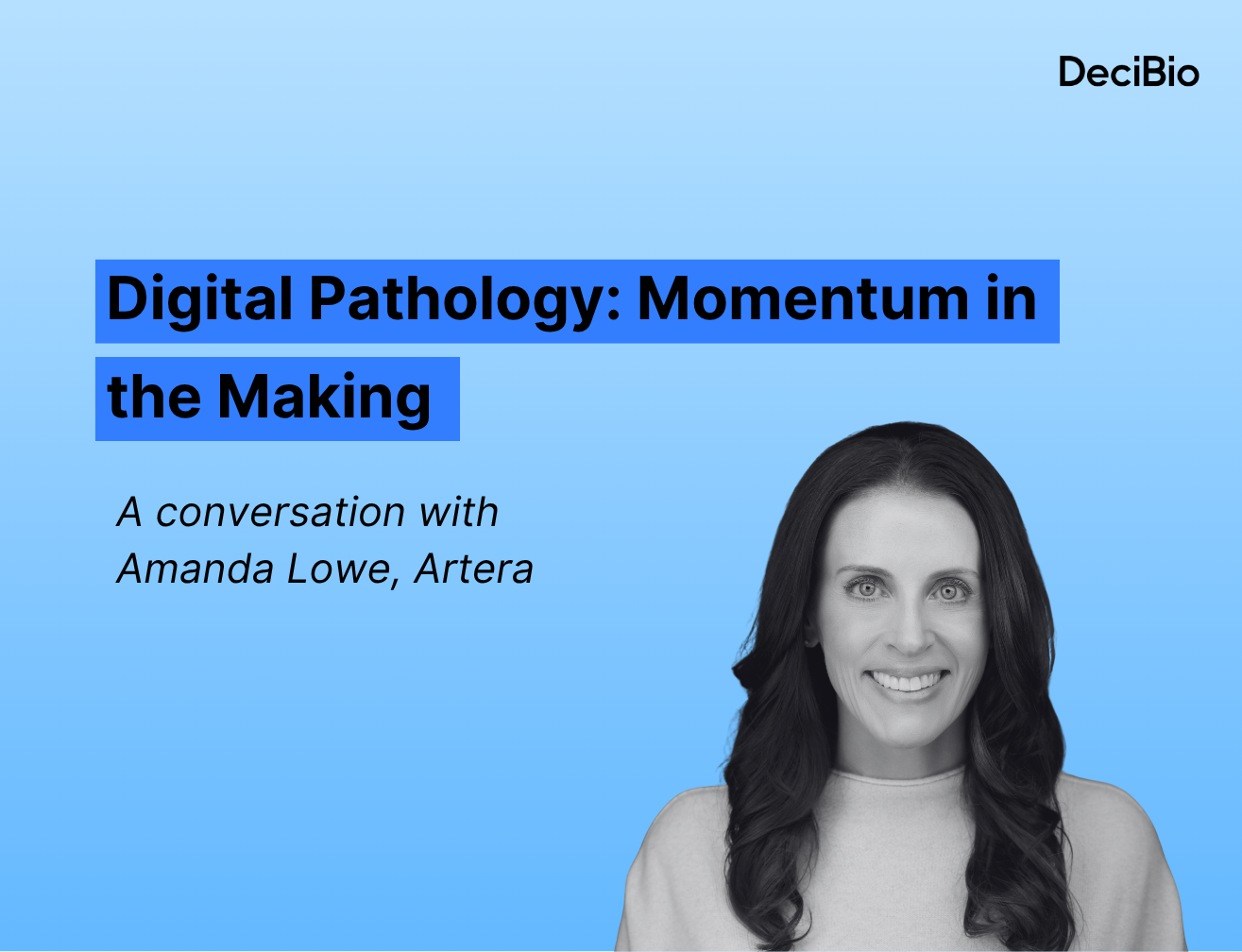


Following Artera's recent FDA clearance for the first-ever digital pathology-based risk stratification tool in breast cancer, we sat down with Chief Commercial Officer Amanda Lowe to take stock of where the industry stands. From the future of companion diagnostics to the ongoing challenges of reimbursement and global adoption, Amanda offers a candid look at what it takes to move digital pathology from momentum to mainstream.
To start, could you briefly introduce yourself and share your background in digital pathology?
Absolutely. I’m Amanda Lowe, the Chief Commercial Officer for Artera. Artera is a precision medicine company that leverages AI, powered by digital pathology, to provide clinicians and patients with actionable clinical insights to personalize their cancer care.
I got started in digital pathology about 25 years ago, initially working for Bacus Laboratories, later Olympus, and then spent 12 years at Visiopharm. In 2024, I joined Artera.
A career in digital pathology really resonated with me because I saw its untapped potential and was confident that digitizing pathology was the right thing to do for patients and would transform healthcare. And it’s been a very rewarding journey, being on the front lines, helping to make it happen.
We were excited to see Artera’s recent regulatory traction, including the AI breast algorithm that was just cleared in May. Fresh off this clearance, how do you see AI-enabled digital pathology impacting patient care in routine clinical settings today?
Thank you, yes, we are so excited about this regulatory progress!
There are several AI use cases that assist pathologists with diagnosis and screening, especially in the companion diagnostic (CDx) world. One of the most common and most well-known is in HER2 targeted therapies. Also, there's Roche's recent breakthrough device designation for TROP2 in non-small cell lung cancer.
To build on that, I think this is where AI in digital pathology can further evolve to really impact patients. Diagnostics that provide both prognostic and therapeutic treatment insights to really help support and elevate those shared decision-making discussions between patients and their doctors around treatment management. I believe AI has a huge role to play in helping to translate all the scientific, medical, and clinical complexities into something far more digestible and practical.
Despite the excitement and anticipation that experts in this space have, we’re still seeing challenges. Ultimately, digitization and computational pathology adoption is uneven. From your perspective, what are the biggest bottlenecks to scaling AI-enabled digital pathology into routine clinical care today?
Having been in this industry for quite some time, I always say, we thought the last decade, we were going to see the tipping point. Now we joke, it's this decade! But the fact is, it's always been tipping. We've been making incremental steps towards long term change.
Broadly speaking, adoption of any new technology always comes down to three things with the first being clinical impact. Second is reimbursement, are we going to actually make some money here and have compelling economics around it? And with digital pathology, there’s a steep transitioning cost that also needs to be overcome. And lastly, will pathologists actually use it? They need to be comfortable psychologically, and not just physically, with using these new tools.
Out of the three, the toughest issue has been regulatory and reimbursement. And though we are seeing milestones being made across the industry in regulatory breakthroughs, whether it's here in the United States through FDA or through CE-IVDR in Europe, it's still a very complex landscape.
I am so thankful for the amazing experts and advisors that we work with to help make sense of the nuances and intricacies. My advice to everyone is to lean in, get involved and work with key stakeholders, as we should all be invested in creating a positive environment. Organizations like the Digital Pathology Association and specialty societies such as the College of American Pathologists are critical for building alignment across the industry.
Our next question connects to data: the core of precision medicine in many ways. How do you see data, including real world data, evolving over the next 5 years to influence digital pathology?
It’s a key requirement in healthcare to have a strong level of evidence, preferably level 1 evidence from prospective randomized clinical trials, especially when you're trying to change the standard of care.
However, real-world and/or retrospective data can also be very impactful. For example, we’ve connected with institutions around the world to conduct single-site studies that further validate results in diverse patient populations. We’ve also invested in registry studies, like our DIRECT AI registry, to demonstrate clinical utility, by comparing physician treatment recommendations before and after the use of our AI tool.
So ultimately, it's not about trying to do everything in one giant study, but more about how to build a comprehensive and robust story throughout these various evidence generation efforts. And I think that this altogether is a good thing, because different studies can address different aspects of patient care.
Transcending from data in a general sense, I’d like to ask about how you think about combining data types: the holy grail of precision medicine. How can we take everything that we have accumulated, and filter it and combine it in a way to bring about more value? What are the nuances around multi-modal data when we look at it through the lens of digital pathology?
It's still the wild, wild west when you think about the world of big data and what everyone's going to do with all kinds of different data. We're uncovering more and more information every single day. From a technical perspective, I think people always think more data is better. But we cannot forget that the quality of data is equally, if not more, impactful, especially in the case of AI models being trained on that data. So I think the question, especially from the FDA’s point of view, isn’t always about the need for big data or more data, but rather more about how to generate quality and reproducible insights.
What we really need to know is what happened to every patient that goes into these AI models in order to help build meaningful, deliverable products. It’s not just about the size, but the quality and the intention behind every datapoint.
Switching gears a touch, I wanted to take a step back and highlight how some of the topics we’ve discussed change when we think about the landscape with respect to regions. Could you elaborate on some of the dynamics to consider for digital pathology’s success around the world? What nuance is behind digital pathology as a global movement?
It’s not a one size fits all when you look at global adoption of AI-powered digital pathology. The market landscape, the regulations, the cultural and medical norms, they all differ region to region.
Going back to the earlier question about adoption challenges, you still have to look at all those key factors for success: clinical impact, regulation, reimbursement, pathology readiness. And those transition costs vary country to country.
For example, how we manage and support patients in the United Kingdom, is very different for patients in Israel. We rely on two separate partnership and distribution models, and that was intentionally designed based on the needs of those specific markets and how best to support patient access.
To wrap things up, what are you keeping your eye on within the digital pathology world? What’s emerging, interesting, or exciting to you?
I must admit, and I know I'm a little biased here, but I do think wider adoption of prognostic and predictive risk stratification tools globally will really drive digital pathology adoption forward. There are a lot of moving pieces, but I believe our tools will continue to become more intuitive and more powerful.
I think that's what digital pathology and AI-enabled tools really need to focus on, solving real pain points for clinicians and patients alike. What helps is that there are so many clinical needs for actionable insights in healthcare. So there's lots of room for innovation in this space, and there is a world of opportunity out there.
Finally, I'll just add that there will always be barriers. We're going to continue to see them. I've always said, you get through one, the next one pops up. So you have to love riding roller coasters in digital pathology! I just happen to be the person in the front seat with my hands up! Through the ups and downs, I always remain confident we can figure it out.
Comments and opinions expressed by interviewees are their own and do not represent or reflect the opinions, policies, or positions of DeciBio Consulting or have its endorsement. Note: DeciBio Consulting, its employees or owners, or our guests may hold assets discussed in this article/episode. This article/blog/episode does not provide investment advice, and is intended for informational and entertainment purposes only. You should do your own research and make your own independent decisions when considering any financial transactions.
.png)

.png)
.png)