

Endometriosis is gaining momentum in biotech and precision medicine, driven by urgent unmet need and growing recognition that its biological complexity demands scientific innovation. For decades, treatment has stagnated around hormonal suppression and invasive surgery—leaving millions undiagnosed or undertreated, and the underlying biology largely unexplored.
Meanwhile, precision medicine fields such as oncology, immunology, and rare disease have spent the past 20 years building the playbook: pathway-specific drugs, molecular diagnostics, imaging-based disease monitoring, and biomarker-driven patient stratification. We’re now beginning to see those frameworks cross over. Innovations used widely across precision medicine—such as targeted therapeutics and advanced molecular imaging—are increasingly applicable to endometriosis, signaling a future where endometriosis can be detected, treated, and monitored with the same sophistication as other complex diseases.
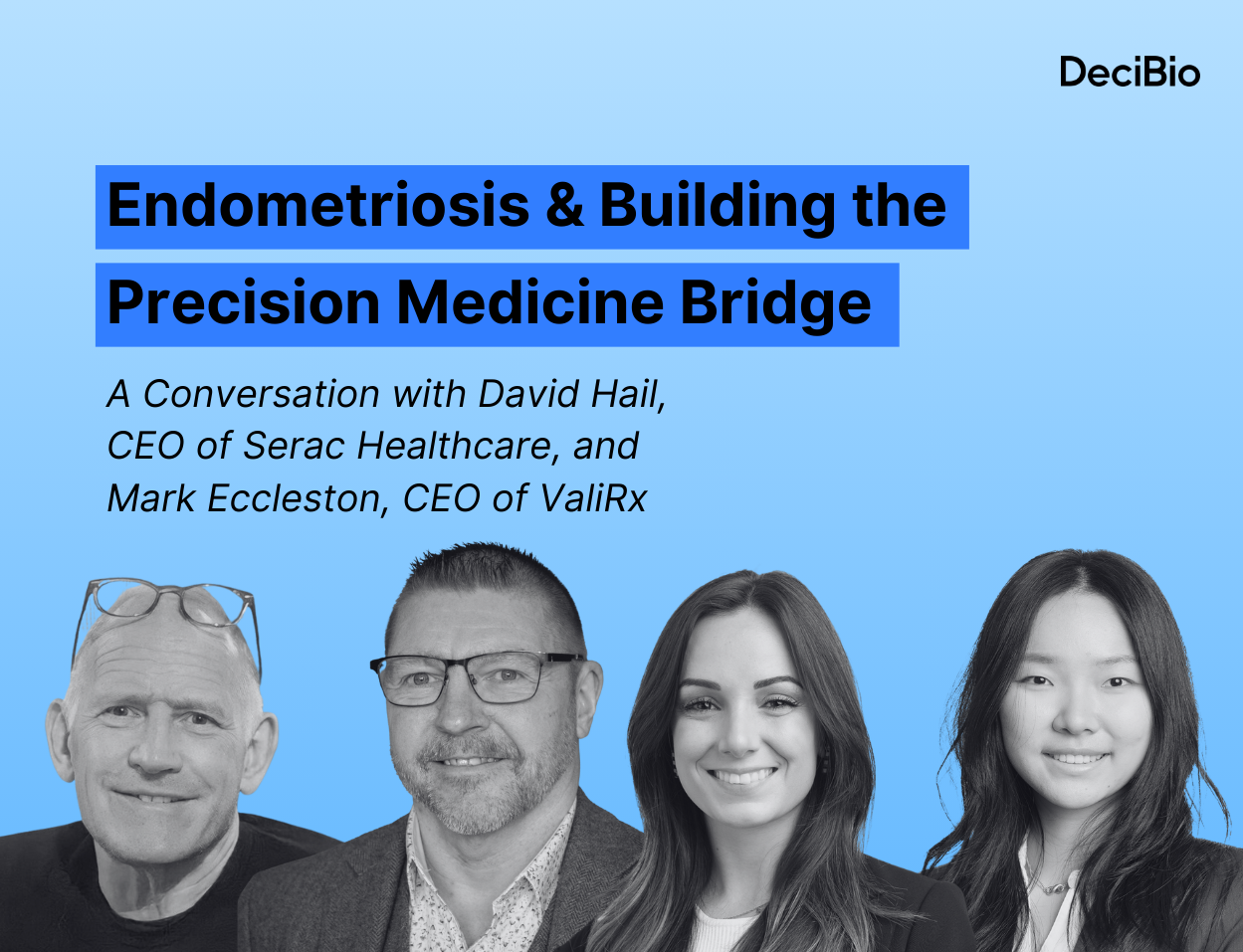
In this joint Q&A, DeciBio spotlights two CEOs, David Hail and Mark Eccleston, bringing precision medicine to endometriosis to advance new diagnostics and therapies. We discuss why endometriosis was a logical indication, what lessons biotech and investors can borrow, and why broadening participation in women’s health—across sector and gender—is essential to moving the category from niche to mainstream
Both of you came from the precision medicine world before endometriosis. Mark, your preclinical endometriosis asset has origins in prostate cancer, and David, your lead radiopharmaceutical focuses on conditions characterized by abnormal angiogenesis. What made endometriosis a logical indication scientifically?
Mark: There are strong parallels between oncology and endometriosis. Years ago, I was working on an early-stage peptide therapeutic with roots in prostate cancer; the pathways involved in androgen receptor / estrogen receptor complexes also show relevance in other disease areas, like breast cancer and potentially endometriosis. I attended a meeting where endometriosis was presented—technical, science-driven—and I remember thinking: these things have to be connected. I’ve always viewed endometriosis similarly to metastatic disease: cells proliferating in places they’re not meant to be, driving vascularization and inflammatory responses. The deeper you go—kinase pathways, SRC signaling, microenvironment and cytokines—the more the parallels emerge.
David: Our molecular imaging agent, maraciclatide, binds αVβ3 integrins, which are upregulated in angiogenesis. Angiogenesis is a cardinal feature of many inflammatory diseases, and endometriosis has that inflammatory and angiogenic underpinning. When endometrial tissue grows outside the uterus, it needs its own blood supply, which drives both angiogenesis and local inflammation. What really encouraged us was the pull once we started talking about our endometriosis work—patients, clinicians, and regulators. When we saw Ph 2 data, it became clear this could be a foundational tool for the field. We’ve seen its effectiveness in other settings such as inflammatory arthritis and rheumatoid arthritis, specifically to show active disease.
What might help facilitate more “crossover innovation” from precision medicine fields to women’s health?
Mark: People need to be more open minded and less siloed in their thinking. My strength as a scientist is I’m a generalist, not an expert in any one area. Disease isn’t a single problem—it’s a collection of different things. Endometriosis is complex; cancer is a complex set of diseases. Individual components may be solvable, but won’t fix the overall problem on their own. You’ve got to be receptive, think more laterally about disease, and look for parallels. We run a drug repurposing program, taking non-oncology drugs into oncology. If you understand the biology, you can apply the drugs in other indications as well.
David: I agree with Mark. One thing I’d add is our industry encourages specialization—depth of knowledge over breadth of knowledge. And of course that matters. But what can cut across that is curiosity—an indefinable quality that’s more innate than something you can teach. The ability to think across boundaries and silos is what really matters, and curiosity enables that. Curiosity is the force multiplier that makes a fundamental difference.
The other piece is evidence of success, from somewhere, from someone, and people follow. People follow perceived success, something that can improve the world, and bluntly where there’s potential for financial return to bring investors in.
Our team just finished a 5-part series on precision medicine in endometriosis, exploring potential disease-modifying treatments in development, one of which is ValiRx’s preclinical asset. Where do you see the clearest opportunities for precision medicine in endometriosis and what lessons from precision medicine should this field adopt?
Mark: Our approach is not a shotgun ablation of hormones. Hormones are required for normal function—you want them present, not eliminated. We’re looking at selectively downregulating specific pathways driven by hormonal activation. We don’t block hormonal activity or kinase activity; we block the interaction between the two. That allows us to downregulate specific non-genomic signaling events. A more selective strategy is the way forward for benefiting patients while maintaining a low side effect profile.
David: One of the key issues is that 50% of women undergoing fertility treatment have endometriosis, making it a leading cause of infertility. Hormonal treatments are not viable if you’d like to start a family. That’s a fundamental issue that precision therapeutics has the opportunity to solve—and exciting to give women choices about when to start a family, not compromised by endometriosis.
Compared to other fields, precision medicine in endometriosis is still relatively early. Beyond your own programs, are there early signals that point to promising precision medicine opportunities?
Mark: It comes down to deeper biological analysis, particularly multi-omics to identify markers that lend themselves to precision approaches. That might include preventing dissemination of cells, targeting kinase pathways, cytokine downregulation, siRNAs with amenable targets, and angiogenesis. One key difference from oncology is mutational burden. In cancer, even highly precise therapies often miss a cell that can come back resistant. Endometriosis doesn’t have that, so you have the potential for a more protracted response.
David: There’s still debate around the underlying mechanisms, but the commonly accepted model is retrograde menstruation, making endometriosis a progressive, recurring disease. If most women experience retrograde menstruation, the key question is why only 10% develop endometriosis. That is one of the really interesting questions to be solved.
Mark: A useful analogy is COVID—most people were infected, but outcomes varied widely, likely due to underlying inflammatory states. Endometriosis may similarly involve retrograde menstruation plus another factor that enables lesion persistence and progression. That raises important questions about early intervention and disease prevention.
Endometriosis diagnosis lags on average 7-10 years. Other fields advanced through imaging and minimally invasive diagnostics. What’s the equivalent path here, and what are the limitations?
David: It starts with credible, peer-reviewed clinical evidence. If data holds up against gold standards, it drives everything that follows: clinical adoption, payer attention, regulatory momentum, and ultimately therapeutics. For endometriosis, that means unequivocally identifying superficial peritoneal endometriosis—arguably active early disease—against the current gold standard. If you can do that, you can meaningfully shorten the diagnostic gap in a way clinicians will accept.
The challenge is that women’s health diagnostics sometimes mixes data-driven science with more socially driven narratives, which are important but don’t always align. To advance diagnostics in women’s health, you need the same evidence-based approach as you would with any other area of medicine.
Mark: I’ve seen pushback in biomarkers and multi-cancer screening—it’s not just “can you detect something,” but what do you do next, and what’s the risk of overdiagnosis? Clinical utility is key. Proving that requires expensive, case-controlled trials.
There’s been significant work on endometriosis biomarkers, non-invasive monitoring, and liquid-biopsy approaches, but localized disease is extremely difficult to detect through blood. Even when biomarkers work, they’re usually screening or risk tools, not diagnostic. True diagnosis comes from approaches like David’s that allow you to see disease directly—much like prostate cancer, PSA helps but MRI ultimately changed the paradigm.
What should a diagnostic trial look like to be representative and clinically meaningful?
David: You need comparison against a true gold standard. In our Ph 2, we used laparoscopic surgery because it’s the only definitive measure of stage, location, extent, and severity of endometrial disease. We designed it as an all-comers study, including patients on hormonal treatments, because a diagnostic has to work in the real world. Narrow criteria risk pre-selecting already diagnosed patients. Regulators supported our approach, and our Ph 3 studies are essentially larger versions of Ph 2.
Mark: And it’s exciting because if your diagnostic is approved before any of our drugs reach late-stage trials, it becomes a critical readout for everyone developing therapies.
How do we think about disease monitoring and clinical trial endpoints? Oncology for example shifted beyond “overall survival” to surrogate endpoints and tools like ctDNA / treatment response monitoring.
David: In inflammatory arthritis, clinicians need to know whether they need to change course, taper treatment, or continue, without risking a flare. Monitoring should answer those questions. We initially developed maraciclatide with that in mind. Endometriosis has leapfrogged because of the unequivocal need for a definitive measure of endometriosis, especially in very early stage disease.
Therapeutic development is bottlenecked by current gold standards: laparoscopic surgery at baseline or follow-up is formidably difficult, and pain-based endpoints result in large, confounded, self-reported studies. A viable alternative wouldn’t just change diagnostics, but provide a foundational tool for therapeutic development, mirroring oncology; early diagnosis, more efficient treatments, real-time treatment response monitoring, and a more quantifiable metric and endpoint for clinical trials.
Mark, you mentioned your interest in endometriosis sparked outside a women’s health conference. What would it take for endometriosis to become more common at conferences like JPM, ASCO, ESMO, or PMWC? And what biological or translational questions need to be answered to unlock true precision medicine?
Mark: Disease characterization is key. Multi-omic approaches—single-cell sequencing, proteomics, and emerging areas like ribo-seq—allow us to better understand complex cellular systems. Endometriosis involves endometrial cells interacting with many other components, and teasing apart those interactions naturally leads to strong science, publications, and conference interest.
People are drawn to technical challenges. At our company, everyone I know is curious. We’ve thought about integrating patient-derived endometrial tissue with cancer-associated fibroblasts to build more representative inflammatory models. Disease associated fibroblasts aren’t exclusive to cancer; they appear in endometrial tissue too. Are they the same? Can better models improve drug development? We need better predictive models, ideally non-animal, that allow us to track real-time responses and evaluate therapies more effectively. That kind of curiosity-led innovation will bring endometriosis into broader scientific forums.
The belief that women’s health must be led only by women still comes up in biotech. As male CEOs working in endometriosis, what’s your response—and what would you say to men hesitant to enter the space?
Mark: These are some of the hardest problems, so you want the best people, regardless of chromosomes. At our company, many senior leaders and advisors are women, not because of quotas, but because they’re the right people for the job. What matters is passion and genuine desire to solve unmet disease areas. That’s what drives our team.
David: The argument cuts both ways. Excluding 50% of the population from leadership damages a business. Excluding people who want to help solve women’s health problems does no good. Women’s health is already underfunded and underprioritized. If anything, we need more men who are committed to advancing it, just as we need more women. Excluding men on principle just creates another silo.
What works for engaging stakeholders outside the “traditional” women’s health community to make this space more mainstream?
David: It comes down to one word—success. People follow success and it’s a self-fulfilling prophecy. The challenge is getting early efforts visible enough to build momentum, which is why having all the allies you can get, plus a few more that may be sitting on a fence somewhere, is so important.
Mark: I agree—there’s no gender divide in science. Opportunity follows effort, results, and commitment. The industry is hard for everyone, to find money, get investors, but you have to commit and go for it. And it also comes down to things like mentorship and role models.
Before we wrap up, what are you most looking forward to in 2026? Or what did you most take away from 2025?
David: 2025 was a great year for us. We’ve made fantastic progress across all our clinical studies, not just in our lead indication, endometriosis, but also in inflammatory arthritis and interstitial lung disease which is another really exciting area for us. Specifically in endometriosis, we completed our Ph 2 study with Oxford University which has been a great collaboration, and had very positive discussions with regulators about our Ph 3 path. We know exactly where we’re going next and can take a big step forward. For any biotech, moving an asset from early development through Ph 3 is a big deal and the level of reinforcement and encouragement we’ve received has been very motivating.
Looking ahead to 2026, I’m extremely excited to kick off our Ph 3 studies in endometriosis, building on the great data we already have, towards a validated, definitive diagnosis for superficial peritoneal endometriosis. That would make 2026 another great year!
Mark: For me, 2025 was my first year as CEO of this company, and it was a steep learning curve. But recognizing that we have assets that can make a significant difference to patients is ultimately what drives everybody in the company.
Looking ahead to 2026, we’re focused on progressing those assets. I’m really excited about reinitiating our endometriosis program— leveraging both the work we’ve already done and new work underway. We’re doing work in prostate cancer that can benefit endometriosis —a good example of healthcare that works in men and women. Much of the initial development work only needs to be done once, allowing us to apply that investment across indications.
Thank you both for the interesting, cross-disciplinary conversation!
*** In this conversation, we draw parallels between oncology and endometriosis because oncology offers a useful blueprint for how precision medicine can transform care. Importantly, endometriosis is a benign, non-cancerous condition and is not considered a premalignant disease. While certain biological features discussed may overlap with those studied in oncology, these parallels do not imply disease equivalence or malignant potential.
Comments and opinions expressed by interviewees are their own and do not represent or reflect the opinions, policies, or positions of DeciBio Consulting or have its endorsement. Note: DeciBio Consulting, its employees or owners, or our guests may hold assets discussed in this article/episode. This article/blog/episode does not provide investment advice, and is intended for informational and entertainment purposes only. You should do your own research and make your own independent decisions when considering any financial transactions.

.png)
.png)