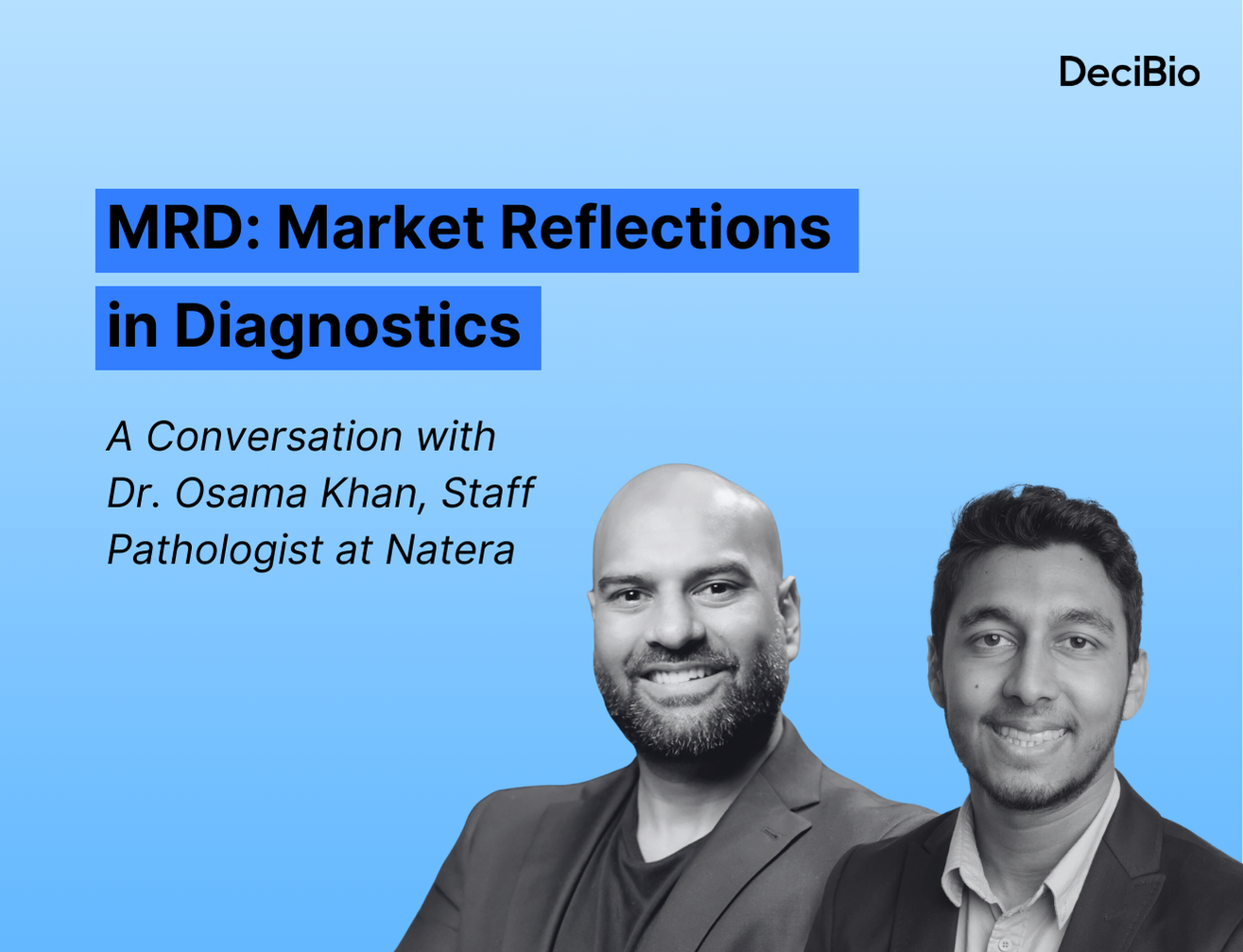

We recently interviewed Dr. Osama Khan, a Staff Pathologist at Natera, a personalized genetic testing and diagnostics company. See the full transcript below.
1) Thank you for joining us, Dr. Khan. To start, could you share a little bit about your background, including your transition to industry from academia as a pathologist?
Thanks for having me, Amal. To begin, I’m a board-certified anatomical pathologist. After medical school, I completed five years of anatomical pathology training in Canada, followed by a fellowship in genitourinary pathology at Stanford University. During my time at Stanford, I also consulted for digital pathology and AI companies, which sparked my interest in emerging technologies within the pathology workflow.
Although moving into industry early in a pathology career is somewhat uncommon, being in Silicon Valley exposed me to mentors and organizations working at the intersection of biotechnology and medicine. That environment played a major role in shaping my career path.
Those experiences ultimately led me to my current role at Natera, where I’ve been for the past three years. Natera focuses on genomic cell-free DNA testing, including oncology applications such as MRD testing, a topic I’m sure we’ll explore more deeply in this interview.
2) MRD is a rapidly moving space, but it remains relatively early in solid tumors and is not a routine test for many people in the solid tumor space. How do you define MRD? Is it just one terminology? If there are many, how does that change?
Some define MRD as minimal residual disease, while others use molecular residual disease. I prefer the latter because it better reflects the underlying biology. In essence, MRD refers to detecting small amounts of cancer remaining after treatment, levels that are often undetectable with standard imaging or routine clinical tests.
MRD testing relies on identifying circulating tumor DNA (ctDNA). When normal cells die, they release small fragments of DNA, cell-free DNA (cfDNA). Tumor cells do the same, but their DNA contains tumor-specific molecular signatures. By quantifying ctDNA, we obtain a real-time view of a patient’s tumor burden.
Because ctDNA has a short half-life, any detectable signal strongly suggests active disease with high sensitivity and specificity. This makes MRD extremely powerful: ctDNA can reveal recurrence months, sometimes years, before it appears on imaging or through conventional clinical assessments, allowing providers to make earlier and more informed decisions.
3) Since you brought up imaging, how do you view the dynamic between different testing modalities and information, and where does MRD fit in? For example, there is traditional imaging or pathology/histology findings, and then even genomic profiling information, like the actual mutational status rather than just the ctDNA level. How do you think MRD should be layered on or even prioritized compared to these?
Cancer care is inherently multidisciplinary, and that’s exactly how MRD testing should be viewed—another tool that complements imaging, pathology, and molecular profiling. I often tell people that it gives the oncologist and pathologist another tool in their cancer diagnostic toolbelt.
By the time a patient reaches the point where MRD is used, they have already undergone diagnostic imaging, tissue biopsy, and often genomic profiling to guide personalized treatment options.
MRD comes into play later in the care pathway, primarily for post-treatment surveillance. It helps us understand how well a patient is responding to therapy and whether their disease is truly cleared at the molecular level. That information is critical because it can guide decisions about escalating or de-escalating treatment.
In terms of prioritization, MRD isn’t meant to replace existing modalities but to enhance them. Clinical trials have consistently shown that integrating MRD with standard treatment workflows leads to better outcomes. Patients who remain ctDNA-negative tend to do well, while rising ctDNA levels can signal the need to adjust or intensify therapy. In that sense, MRD adds a powerful, real-time layer of precision to the overall cancer care strategy.
4) I want to call back to something you mentioned earlier: your interest in cutting-edge technologies. I understand you have worked with digital pathology, for example, as a pathologist. What do you think will be most impactful on clinical diagnostics in the near future?
That’s a great question Amal, and one that I am particularly passionate about. Pathology has traditionally been viewed as a very hands-on specialty, microscopes, glass slides, and direct visualization. Digital pathology is transforming that. High-resolution scanned images not only improve how we view tissue for diagnostics but also create shareable and analyzable data. Instead of physically shipping slides for a second opinion, a case can be reviewed instantly by pathology colleagues anywhere in the world relatively instantly.
A strong digital pathology infrastructure is becoming essential, not just for workflow but also for integrating emerging technologies. AI is a good example and I tell my colleagues pathology is not immune to AI’s influence. In fact, many algorithms rely on high-quality digital images to help triage cases, support diagnoses, and analyze tissue at the cellular level.
AI is has also expanded into biomarker detection, such as HER2 and PD-L1, tests that guide eligibility for targeted therapies. These assessments can be complex, and AI offers valuable support by improving consistency and reducing interpretive burden by pathologists.
Digital pathology also ties directly into MRD workflows. When we evaluate tissue for downstream molecular testing, high-quality digital images help us identify the areas richest in tumor tissue content for downstream testing. Overall, the combination of digital pathology and AI will play a powerful role in shaping the future of diagnostics.
5) Where do you see the pathologist's role evolving in the era of MRD-driven oncology? Is MRD something pathologists like you will be increasingly driving, or is it a joint decision with oncologists?
I think it’s important for pathologists to recognize the central role we play in a patient’s cancer journey. We should have a seat at the decision-making table, and often help lead those discussions, alongside our clinical colleagues.
With MRD testing specifically, a major part of my work involves peer-to-peer conversations with pathologists and oncologists. I remind them that we are the tissue experts, and our input is essential in selecting the most appropriate specimen for testing.
Because MRD is still a relatively new technology, familiarity varies widely amongst my clinical colleagues. This puts pathologists in a unique and natural position to educate teams about how MRD works and which tissues are most suitable for analysis.
In doing so, we inherently become patient advocates. We emphasize both tissue quality and tissue stewardship, making sure we choose the optimal sample so that we don’t exhaust limited or irreplaceable tissue from biopsies or surgical resections.
Just as pathologists have been integral to diagnostics and molecular testing within academic centers, I believe we will play an equally important role in the implementation and advancement of MRD testing moving forward.
6) You just mentioned education could be one barrier to MRD adoption, and another could be tissue availability for tumor-informed assays. Are there any other barriers to MRD adoption that you see, and if so, any thoughts on how to overcome them?
Beyond those factors, one major barrier is the need for strong, widely understood clinical evidence. For any new technology to gain traction, clinicians need to see consistent long-term data demonstrating assay accuracy and clinical utility. If they aren’t aware of that evidence, it can be difficult for them to fully trust or adopt MRD testing.
Another challenge is the complexity of the assay itself. Many clinicians don’t fully understand how MRD and ctDNA testing work, because these tests involve multiple steps and specialized workflows. A key part of my role is to explain the process and help providers understand where they fit into it. With pathologists specifically, I focus on how they can support tissue selection and stewardship. If they don’t know the technical requirements, the test can feel difficult to incorporate into routine practice.
Finally, insurance and regulatory issues can be significant barriers. Because MRD is still relatively new, coverage is not always guaranteed, and cost can be a concern for patients. It’s important to address these questions proactively, whether the test is covered, how it fits into guidelines, and whether it can be integrated smoothly into the patient’s care plan.
Comments and opinions expressed by interviewees are their own and do not represent or reflect the opinions, policies, or positions of DeciBio Consulting or have its endorsement. Note: DeciBio Consulting, its employees or owners, or our guests may hold assets discussed in this article/episode. This article/blog/episode does not provide investment advice, and is intended for informational and entertainment purposes only. You should do your own research and make your own independent decisions when considering any financial transactions.
.png)

.png)
.png)