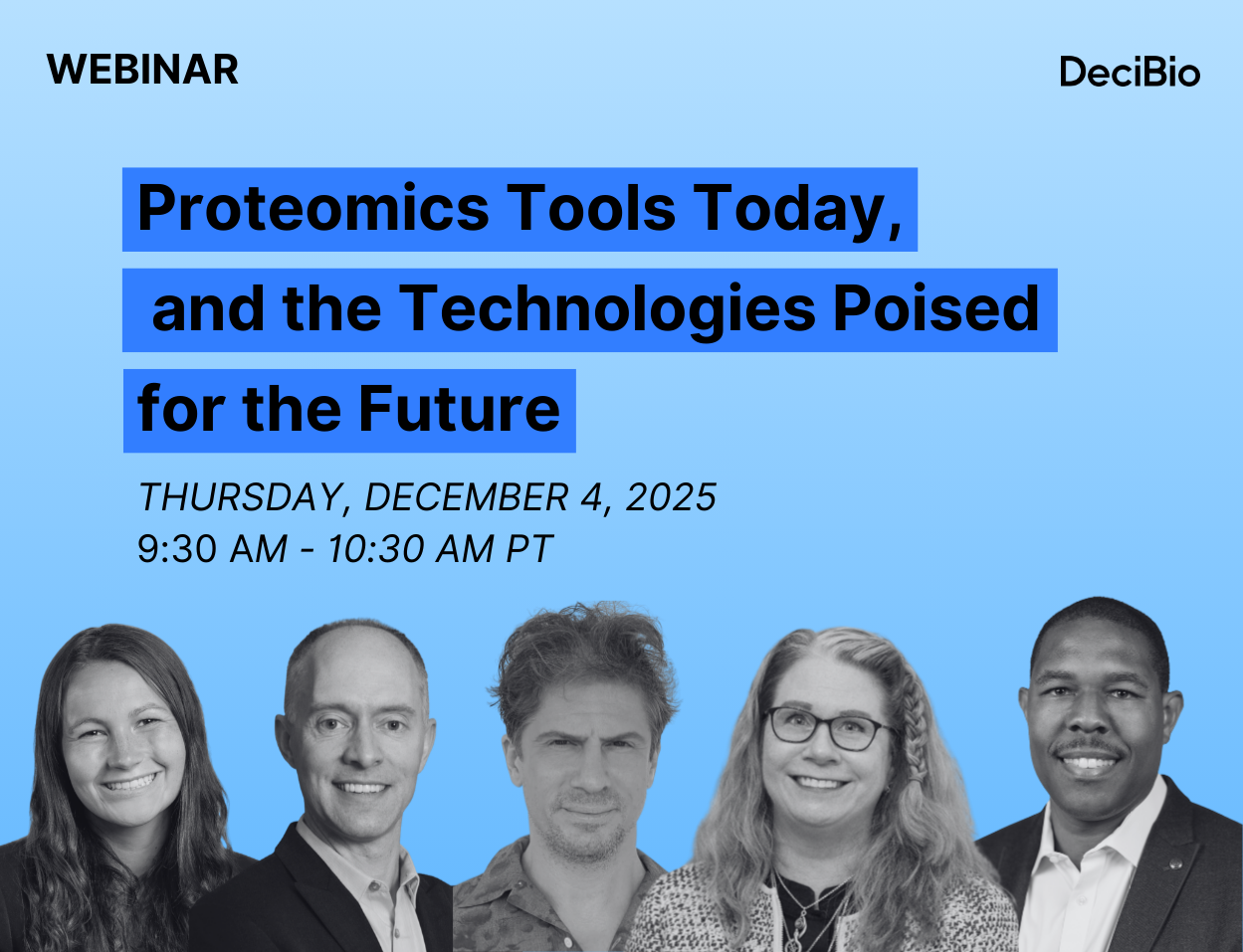


This webinar was recorded on Thursday, December 4, 2025.
Key Insights from the Proteomics Tools Webinar
The proteomics landscape is entering a new era of innovation, defined by faster, more sensitive platforms and an accelerating convergence with multiomics. Our recent webinar brought together industry leaders to discuss the current state of proteomics tools and the technologies poised to reshape research and clinical diagnostics.
Guided by the Report's Authors
Hannah Glazier, Product Manager at DeciBio and co-author of the newly released Proteomics Tools Market Report, highlights the diversity of the current ecosystem. She noted that while the broader market overall has growth in the low-single-digits, more extreme pockets of growth are emerging within novel technologies like high-plex affinity assays, protein sequencing, and spatial proteomics.
A Complementary Ecosystem
The relationship between traditional tools like mass spectrometry and the "new wave" of technologies such as protein sequencing and high-plex affinity is currently defined by complementarity rather than competition. As Serafim Batzoglou, PhD (Chief Data Officer, Seer) noted, the proteome is highly dynamic and complex; no single technology captures the entire picture. Researchers require multiple "readings" or projections of the proteome to build a complete understanding, leveraging the unique strengths of sequencing for PTMs, affinity for low-abundance detection, and mass spec for unbiased discovery.
The Path to the Clinic
The transition from discovery to clinical utility represents a massive shift in the market. Lori Mull, PhD (Senior Product Manager, Psomagen) highlighted the immense potential in neurodegenerative diseases and oncology, noting that proteomics is finally delivering on the promises initially made by genomics, such as identifying causative proteins for Alzheimer’s years before symptoms appear.
Jeff Hawkins (CEO, Quantum-Si) pointed out the practical hurdles in defining the "minimum viable panel" for diagnostics. While broad discovery might identify 160 markers for early cancer detection, the regulatory and clinical reality often demands a smaller, highly validated panel. Panelists ultimately agree that adoption will favor whichever solution is the best fit for the specific use case, regardless of how complex the underlying assay is.
The AI and Multiomics Frontier
AI is becoming indispensable for data interpretation, multiomics integration, and even novel protein design. Panelists discussed challenges to its adoption, including how it can be leveraged in analyzing omics data properly given the variability across different sample types. Miguel Edwards, PhD (Partner, DeciBio) added that resolving discordance between different omic datasets often comes down to the biology itself, looking downstream to see which pathway impacts are real. Ultimately, while regulatory frameworks for AI-driven multiomics are still evolving, the potential for these tools to revolutionize precision medicine suggests the total addressable market for proteomics is likely significantly understated.
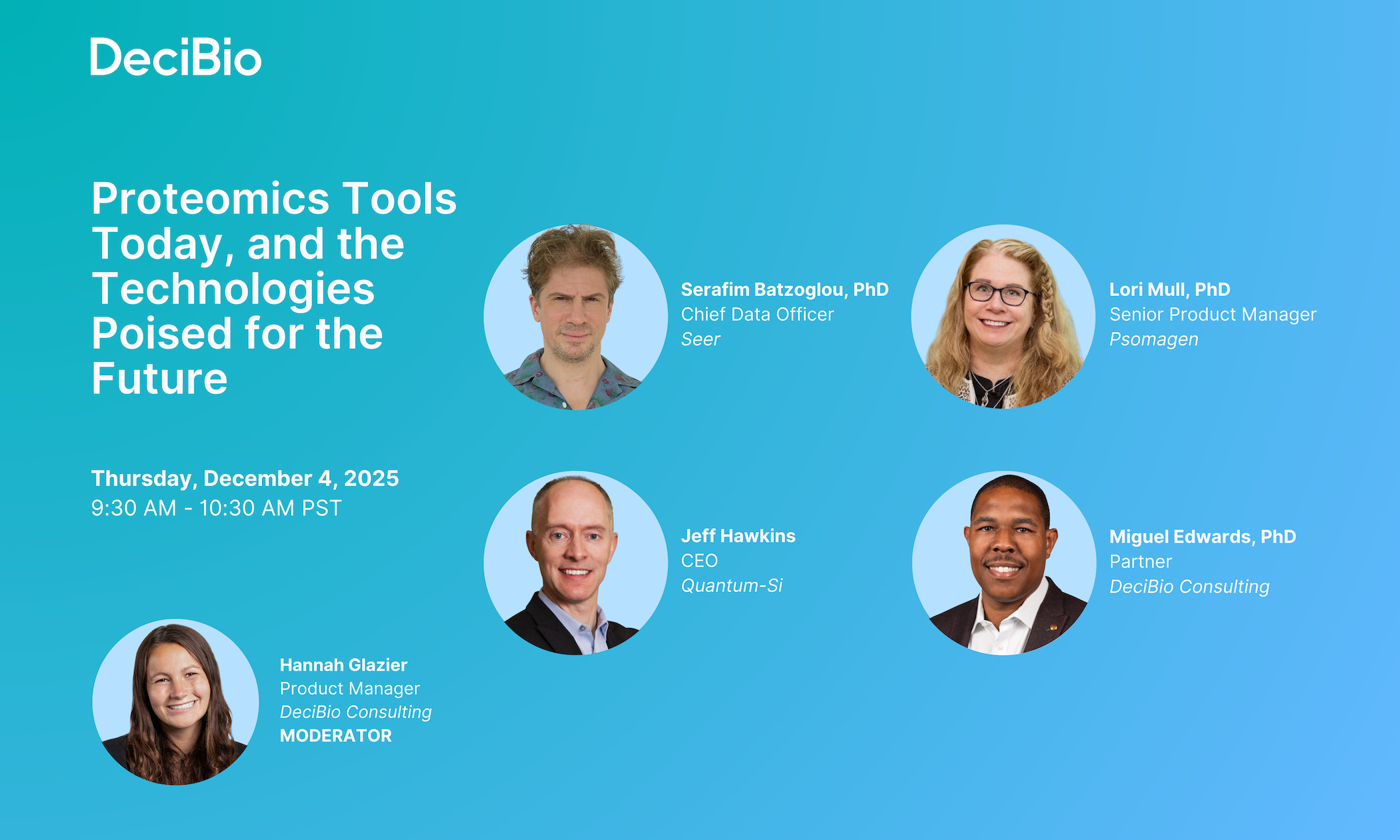
Speakers:
- Jeff Hawkins, CEO, Quantum-Si
- Lori Mull, PhD, Senior Product Manager, Psomagen
- Serafim Batzoglou, PhD, Chief Data Officer, Seer
- Miguel Edwards, PhD, Partner, DeciBio Consulting
Moderator:
- Hannah Glazier, Product Manager, DeciBio Consulting
About the Report
Our report provides a comprehensive overview of the global Proteomics Tools market. It covers the landscape of instruments, consumables, and software used for protein analysis, including breakdown by technology type (Mass Spectrometry, Affinity Reagents, Protein Sequencing), application, and geography.
DeciBio’s Proteomics Tools Market Report, First Edition is now available for purchase. Download a sample of the report here.
Check out our full webinar below to hear the full insights and more.
Webinar Recording:
.png)

.png)
.png)