

For years, healthcare symbolized the slow lane of digital transformation. Legacy systems, long procurement cycles, and highly sensitive workflows made modernization feel incremental at best. Yet, over the past two years, healthcare has quietly become one of the fastest adopters of applied AI.
The question is not whether the sector invited experimentation anymore. The question is why it shifted so quickly, and which parts of the system are actually benefiting.
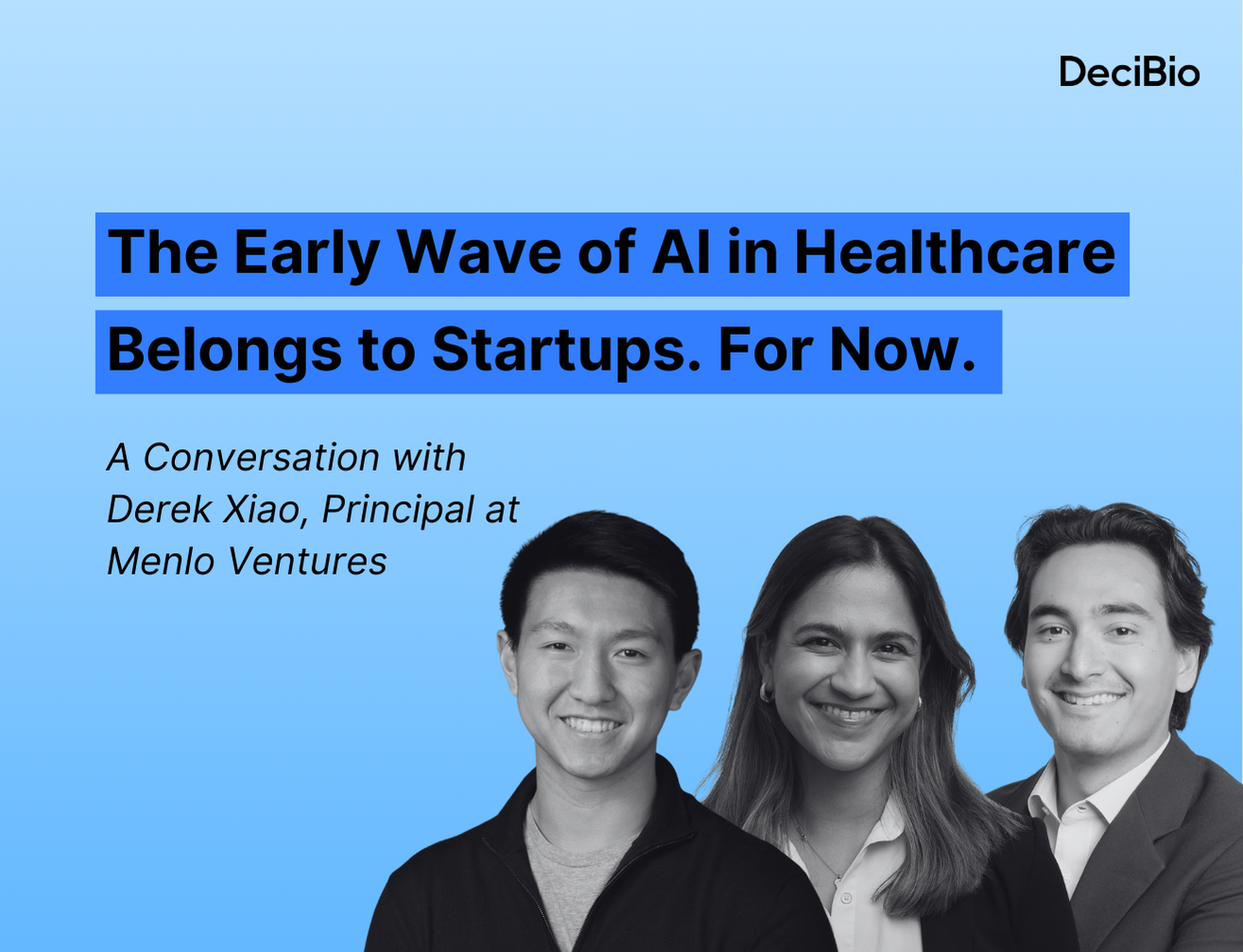
To understand the change, we spoke with Derek Xiao, a Principal at Menlo Ventures, whose team runs an annual enterprise AI survey and recently published an in-depth report on AI in healthcare. Where relevant, we also compare his observations with broader market activity, published research, and examples from health systems to give a fuller picture of the evolving landscape.

Why Did Healthcare Move Faster Than Expected?
Menlo Venture’s survey shows that companies deploy domain specific AI tools in healthcare at a rate that appears higher than in many other enterprise categories. While this data is early, several factors likely explain the acceleration.
First, clinicians and hospital administrators started experimenting with LLMs like ChatGPT immediately after its release. This personal exposure may have lowered the psychological barrier to trying AI at work. Second, AI’s first successful health use cases promise obvious and immediate value. Ambient documentation, revenue cycle assistance, and prior authorization reduction require no philosophical debate. They save time, reduce frustration, and often improve billing accuracy.
A lot of the truths that ended up being commercially very successful are actually ones that are relatively simple… ambient scribing works because you say something and some AI transcribes… as an operator, that’s a super easy sell.”
Xiao notes that health-systems such as Mayo Clinic appear to be moving toward large-scale AI commitments and quicker pilot-to-scale models. For example, Mayo Clinic recently launched its Platform_Insights program to help providers deploy AI solutions, and the institution reports more than 200 active AI projects in varying stages of development.
This does not signal a suddenly-nimble sector. It does signal that the fear of missing a potentially transformative technology actively influences buyer behavior more than it has in previous cycles.
Why Did Start-Ups Capture the First Wave?
Menlo Venture’s Survey also suggests that a large share of early AI spending in healthcare currently flows to startups rather than incumbents. Xiao attributes this mainly to a technical and organizational mismatch. AI development requires engineers who are comfortable with nondeterministic behavior and rapid iteration. Most traditional healthcare IT organizations were not structured for such a shift.
Startups, however, that were already experimenting with speech recognition, clinical documentation, or automated coding had the right habits and product surfaces when generative models became viable. In some cases, they were simply first to offer a working tool at the moment clinicians were trying LLMs on their own time and wondering why their EHR could not do the same.
Incumbents, including major EHR vendors, were slower. The reasons vary. Some lacked AI engineering talent. Others had significant technical debt that made integrating probabilistic models difficult. Xiao also notes a recruitment disadvantage for firms located far from established AI talent pools. Attracting top model and infrastructure engineers remains difficult even with available capital.
Recruiting AI talent is absolutely crazy and Epic is based in Wisconsin plus doesn’t have much of a Silicon Valley presence… to convince someone to move to Wisconsin to work for Epic is actually going to be a very uphill battle.”
How Can New Entrants Differentiate?
Early adopters keep gravitating to simple tools that solve an obvious problem. Ambient scribing and revenue-cycle automation work because they reduce administrative friction without demanding trust in a clinical model. While attractive, these products present a critical drawback: their simplicity makes them easy to replicate, threatening a significant moat. If major EHR vendors release built-in tools that are good enough, health systems may prefer to consolidate back into their existing tech stack.
We asked, in the ambient scribe space specifically, would you rather buy from your EHR or from a startup? People were like 50/50. Epic tends to bundle things into the core product, and if they give away an ambient scribe for free, a lot of hospital systems are just going to go with the EHR solution.”
For startups, the question becomes unavoidable: what creates a lasting position in the stack if the first successful feature can be bundled by an incumbent?
According to Xiao, the most durable value will come from broader workflow control; it’s harder to replace an AI system that reads and writes into the EHR, spans multiple teams, and links provider and payer workflows. This idea echoes findings from research into healthcare IT integration: workflow fit and the ability to co-create with clinicians are strong predictors of long-term adoption and defensibility.
This structure also reflects how companies created staying power if they entered early on. EHR platforms, for example, became entrenched not because of a single feature, but because the system eventually touched every part of the hospital’s operations. Once that level of dependency forms, displacement becomes difficult. AI products that expand horizontally into intake, referrals, prior authorization, or payer interactions could develop the same structural weight.
Still, Derek highlights that the outcome remains open. Many startups may launch compelling first features only to find them bundled, replicated, or made redundant by incumbents. Startups can convert early traction into long-term defensibility in this window, but no one is guaranteed success.
What’s The Bigger Picture?
AI in healthcare still works to find its footing, but the early signals are real. Health systems are willing to test more ideas, startups have shown that useful tools can be built quickly, and incumbents are beginning to move with more focus. None of this guarantees a smooth adoption curve. It does suggest the sector now treats experimentation as a normal part of operations rather than an exception.
The next few years will likely determine what becomes foundational and what fades into the background. Tools that deliver consistent value and integrate cleanly into existing workflows are positioned to matter most. Approaches that rely on novelty alone will struggle once incumbents catch up. The field will not be shaped by a single breakthrough, but by steady progress in places where AI reduces friction without adding new risks.
For a sector that spent decades avoiding disruption, this shift in posture carries weight. Healthcare now moves quickly and with intention. The gap between what the industry imagines and what it’s willing to implement keeps narrowing, and that steady, incremental movement often marks a real turning point.
Comments and opinions expressed by interviewees are their own and do not represent or reflect the opinions, policies, or positions of DeciBio Consulting or have its endorsement. Note: DeciBio Consulting, its employees or owners, or our guests may hold assets discussed in this article/episode. This article/blog/episode does not provide investment advice, and is intended for informational and entertainment purposes only. You should do your own research and make your own independent decisions when considering any financial transactions.
.png)

.png)
.png)